 Her name was Bernice Preyer Swift. She was a mere 27 years old when a death certificate was completed on her time here. Her death left behind a daughter who had turned 7 only four days before her death, a younger 5-year-old daughter, and an even younger 3-year-old son to be parented by her bewildered husband, who already struggled to make ends meet as an uneducated laborer.
The story is told that she was apparently pregnant and not feeling well, and made it to John Gaston Hospital (the predecessor of Regional One), the city hospital where blacks were relegated for care in Memphis at that time, specifically, early January 1946. Unfortunately, she presented for care, and, despite demonstrating what must have been a tenuous state when she asked for help, that help never came. She persisted and waited for someone to provide care, but three days after coming in, she was dead.
That poor woman, who was notorious for being “camera-shy” and therefore sadly appears in no known family photographs, was my maternal grandmother, and her story is one that is held close to my heart. This year, August 4th marks what would have been her 100th birthday. There are many aspects of her story that are heart-wrenching, but what is particularly striking right now is that, despite the fact that she died over 72 years ago from pregnancy-related complications (eclampsia a.k.a. toxemia, given her death certificate listings), those of us in healthcare are fully engaged in conversations about concerning trends in maternal and infant death in Black women today.
Seven decades later, I find myself presenting statistics revealing that black women die from pregnancy-related complications at rates 3-4 times those of our white counterparts; what’s astonishing is that this health disparity is even worse than it was in 1850, when our ancestors were enslaved! We are now actually having the hard conversations about the roles of racism and negative bias, which are the main issues implicated in this continuing trend.
It has always been this story of my grandmother that spurred my commitment to advocating for those who are underserved and marginalized, for my family knows too well the truth that Grandma Bernice died because she was poor and black in the Jim Crow South. Her story has been the reason I knew I would always want to expand my reach beyond the bedside and clinical care. She fuels the passion to be a megaphone for those people and organizations who are out on the front lines of our communities, working to see that the Bernice Swifts of the world are able to have access to health care, can find financial resources to buy medicines, can ensure that they are able to help support their households when they haven’t had a fair break with education, housing, or really any of the social determinants of health.
However, there are layers of how her premature death impacted our entire family. Her widow (my granddad) would almost never speak of his late wife and the pain and suffering of the experience of losing a young wife. This, coupled with the fact that we have no images of what our grandmother looked like, has always created a mystery of who she is and how we could best honor her legacy. We only know bits and pieces that we have been able to find through stories of family members, like my grandmother’s brother and my mother’s favorite uncle, Uncle Booker. Of course, I’m partial to his memory of her because he often said of me, “You are the spitting image of my sister Bernice!” Perhaps the fact that my birthday is separated by my grandmother’s by only 3 days has given me solace in feeling that we are almost kindred spirits, and perhaps there is almost a bit of Bernice reincarnate within my very being :-).” My mother, her oldest child, also possesses memories of Grandma Bernice, but having just turned 7 years old only days prior to her death, she scarcely recalls subtleties such as her mother’s fear of thunderstorms and physical characteristics like jet black hair. However, she also fondly recalls a time or two when she and her younger sister were vying for their mother’s attention when reciting alphabets and numbers.
Perhaps the memory that is most etched in our minds about Grandma Bernice is that her last words to her husband, Odell, were “make sure you take care of my children.” Once you hear this gut-wrenching emotional goodbye plea, you kind of feel like you know the essence of the character and spirit and just how beautiful this woman had to be, even without ever having laid eyes on her.
To this end of honoring her last wish, however, it was decided that her children would need to be cared for by their maternal grandmother, so off to New Jersey they went after saying goodbye at their mother’s funeral services. And this set in motion a sequence of events that led to multiple frequent moves among different family members in different cities and what must have been a tumultuous upbringing for my mother and her siblings. In today’s standards, they most certainly would be considered to have been exposed to multiple adverse childhood experiences. However, what their children and children’s children can proudly say is that they are nothing if not the poster children for RESILIENCE!
In all of this reflection on what should be a 100th birthday celebration, what remains is what would have been and what could have been for our Grandma Bernice. Some months ago, my sister and 2 female cousins agreed to embark on a journey with me (to complete the group of all four of Bernice’s granddaughters) on “Defining Bernice.” This would mean trying to discover anything we could to learn more about the grandmother we would never know, and the mother our parents would barely, if at all, remember. We have had enormous help with a distant cousin who is a skilled genealogist for our Preyer family (thanks, Dominique!) with gathering information on our family as a whole and adding context to the information we have on ancestry.com. Unfortunately, we have had significant barriers to piecing together a picture of who our grandmother was because of the time in which she lived and the reality of how much our society didn’t value women and blacks enough back then to even care to document how they lived and died, or that they mattered at all. For instance, her death certificate noted one location for her grave while her newspaper announcement had another. In the end, neither site has grave markers, as it was not common for ‘colored’ people to have grave markers back then. In attempting to find her burial site, neither cemetery exists any longer, and even if they did, there is no documentation of where she is buried, and there are no gravestones marking her final resting place.
Nevertheless, what we do have to define Bernice is our family spirit, and the story of 3 little children who lost their mother at a young and tender age, but triumphed over tragedy. Today, those 3 children have children who have children; they have all almost tripled their mother’s years of life (nobody can be upset for ‘outing’ their ages, this can be discerned with simple math – lol.) Grandma Bernice’s widow remarried and had a family of his, hers, and theirs.
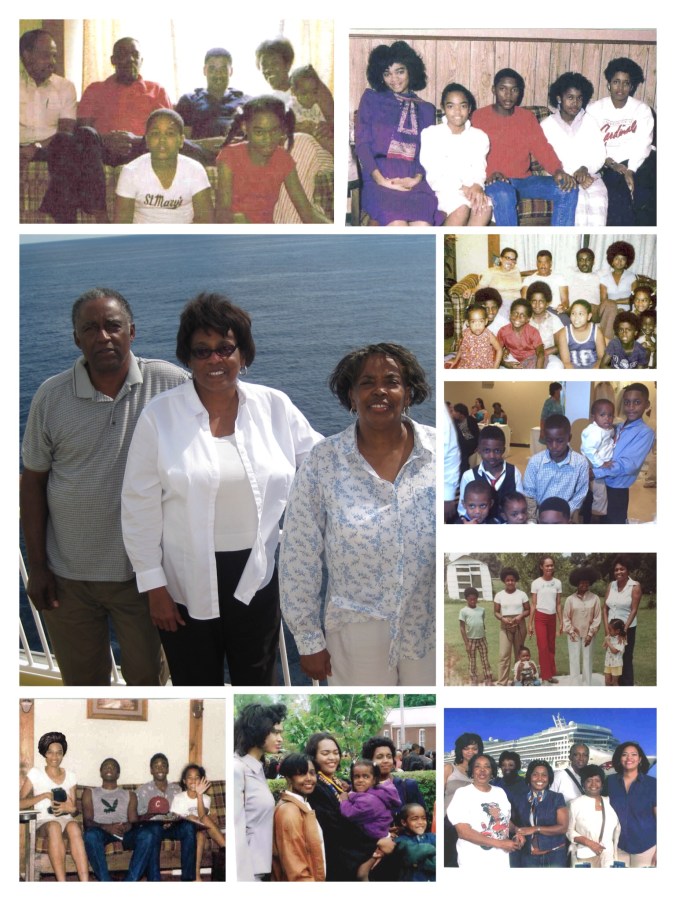
Those 3 children, however, went on to enjoy careers in teaching, the automotive industry, and with the postal service; they all were able to retire and have enjoyed traveling extensively in their Golden Years. The picture above is a collage of the members of Grandma Bernice’s family; her 3 children are pictured together on a cruise in one of the pics.
Despite the troubling statistics with maternal death in black women, there have been obvious advances made since Grandma Bernice’s time. Our parents endured Jim Crow, the Civil Rights Movement, desegregation, and beyond. In return, they were able to experience something that our ancestors and our grandparents would only have dreamed of in the election of our first black president. Although I could now delve into the way the tide has changed since that momentous occasion, I will choose to go in a different direction.
Because of these changes, even the very hospital where Grandma Bernice died is different. Regional One (born of the old John Gaston) is now more committed than ever to providing care to all people, regardless of ability to pay; in fact, a year ago, they launched an initiative aimed at addressing social determinants of health such as housing insecurity to mitigate the impact of these issues, as they contribute to healthcare outcomes more than actual clinical care. (As an aside, years ago, a highlight of my career was being an attending physician at this facility, where I got to care for patients who were newborns just out of the womb to those who were experiencing end-of-life care. The irony of this time and the fact that my grandmother had taken her last breath here associated with pregnancy was not lost on me; it was a full-circle moment of time.)
What a joy it is to think that, just 2 generations later, the lives of Grandma Bernice’s granddaughters are so very different. Because we each carry a little bit of Bernice within us, she has seen access to education and advanced degrees in each and every one of us. Through us, she walks into a couple of Fortune 500 companies every weekday, in one as an account manager for the most well-known pharmacy in the United States, and in the other, as a physician executive for the largest insurance company in the country. She also works tirelessly as an educator for our young people, teaching the children who will lead our future in the very city where she lived her own short life, while a few hours away, she guides and counsels students with special needs through the educational system, while ensuring that the system is also meeting the students’ needs.
And, outside of work, she has traveled the world, sometimes as a part of multiple family members with her children and grandchildren together. Though we are not where we need to be and we have had setbacks, she has been able to vote, have her voice heard, learn that “No” is a complete sentence, and that a woman’s place is inside the kitchen, outside the kitchen, and just about anywhere she very well pleases! She has also been able to experience love and loss, joy and heartache, passion and apathy.
Each of her granddaughters has journeyed past the age of her untimely death at 27. Although I would like to say that we live in a different time in which we are more empowered to be able to advocate for better service and better care if we present in that tenuous state that Grandma Bernice did back in 1946, I really cannot confidently make that claim.
However, what I can say is that, because we hold her story and her memory so close, we appreciate the legacy of who she is and who our parents are, and perhaps this is the gift we are receiving from her on what would be her 100th birthday. When our busy lives give us more opportunity, we will most certainly continue to try to hunt down any possible leads on pictures of Grandma Bernice. I’m sure we will also continue to search archives in libraries and investigate any information we can to further define Bernice.
In the meantime, every day, we get to define who she is a little more by our own living. More importantly, we get to celebrate the fact that, somewhere up there, she knows “My children are just fine.”
 Random Musings by gmowill